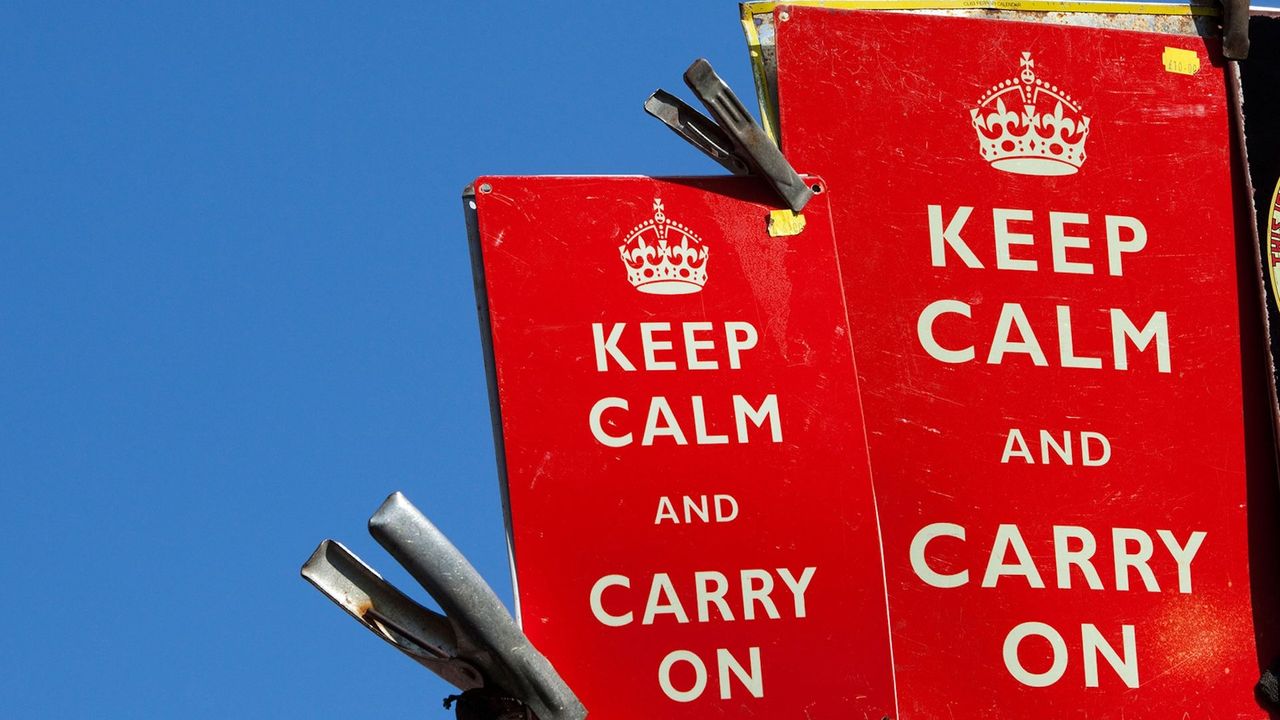
Several modern slogans have undergone significant changes, but none quite like “Keep Calm and Carry On.” Initially an overlooked British wartime poster, this phrase has evolved into an international cultural icon, found on items ranging from coffee cups to protest banners. Its path from obscurity to worldwide popularity highlights the ways in which societies adapt historical symbols to fulfill current demands.
The story begins in 1939, when the British government commissioned a series of motivational posters to maintain public morale during World War II. Three designs were created, with “Keep Calm and Carry On” intended for use only if invasion seemed imminent. Unlike its counterparts “Your Courage” and “Freedom Is in Peril,” which saw widespread distribution, the now-famous red-and-white poster was never officially released to the public. Nearly all original copies were pulped after the war, seemingly consigning the message to historical oblivion.
The slogan’s significant comeback took place in 2000 after a bookseller in Northumberland uncovered one of the scarce surviving original posters within a box of old books. Realizing its visual charm, he and his wife started offering reproductions in their store. The design’s simple typography, bold color palette, and calm message connected with customers, igniting what would turn into an international merchandising sensation.
As the slogan became more well-known in the early 2000s, it experienced a major cultural shift. Initially tied to wartime endurance, its meaning evolved to have more individual relevance, being adopted as a personal motto for dealing with current stressors. Its charm was found in its unlikely mix of British stoicism and modern self-improvement ideals. Before long, the marketplace was inundated with humorous and modified versions, ranging from “Stay Tranquil and Enjoy a Cupcake” to edgier political twists.
This proliferation led to the slogan’s divisive status in contemporary culture. For some, it represents admirable resilience and emotional fortitude. Critics, however, argue it promotes toxic positivity by encouraging the suppression of legitimate concerns and emotions. Psychologists have noted how the phrase can be interpreted either as healthy coping advice or as dismissive of genuine distress, depending on context and delivery.
The commercial saturation of “Keep Calm” merchandise has also sparked backlash. What began as a niche historical curiosity became so omnipresent that many grew weary of seeing it on every conceivable product. The British design firm that trademarked the phrase in 2011 found itself embroiled in legal battles over copyright enforcement, further complicating the slogan’s legacy.
Perhaps most interesting is how the phrase has been co-opted by various political movements across the spectrum. It has appeared at both pro-Brexit rallies and anti-Brexit protests, been used by public health officials during the COVID-19 pandemic, and been adapted by activists for numerous causes. This ideological flexibility demonstrates how effectively the message transcends its original purpose.
The crown logo that originally symbolized royal authority has taken on new meanings in different contexts. Some view it as quaint nostalgia, others as ironic commentary on establishment values. In post-colonial nations, the imagery sometimes carries very different connotations than in Britain, showing how cultural symbols transform across borders and generations.
What stands out about the longevity of this specific slogan is its ability to stay pertinent, possibly due to its vagueness. Unlike other detailed wartime slogans, “Keep Calm and Carry On” provides sufficient direction to seem helpful, yet stays general enough to be relevant in many scenarios. This flexibility has enabled it to evolve from a piece of government propaganda to a commercial icon and a cultural symbol.
As we examine the staying power of this unexpected phenomenon, several factors emerge. The visual simplicity of the design makes it instantly recognizable and easily reproducible. The grammatical structure—an imperative followed by a comforting resolution—proves endlessly adaptable. Most importantly, the core message taps into universal human desires for stability and control in uncertain times.
The development of the slogan indicates widespread cultural transformations in our approach to dealing with difficulties. While the original message dealt with shared national hardships, contemporary meanings frequently relate to personal struggles. This individualization can clarify its widespread appeal as well as the disapproval it receives—what provides comforting validation for some can seem like an underestimation of feelings to others.
Legal experts have discussed the “Keep Calm” case as an example of the intricate nature of intellectual property issues in today’s digital world. Efforts to regulate the duplication of content regarded by many as public domain emphasize the conflict between cultural ownership and the right to free speech. At the same time, marketing professionals are still analyzing why this specific historical piece gained attention while countless others did not engage the public’s interest.
From a historical perspective, the slogan’s journey offers insights into how societies remember and repurpose the past. The original poster’s obscurity allowed for creative reinterpretation unburdened by historical accuracy. As with many cultural phenomena, its meaning lies less in its origins than in how successive generations have chosen to use it.
As we progress deeper into the 21st century, the “Keep Calm” trend remains prevalent. Many new adaptations keep surfacing, reflecting today’s events and societal attitudes. Its persistence indicates that, regardless of our technological progress and societal transformations, some essential human desires—such as comfort, unity, and laughter during challenging periods—persist.
The ultimate lesson of this unexpected cultural journey may be that the most enduring messages are those that say just enough to be meaningful, but not so much that they can’t be reinvented. In an age of information overload, perhaps there’s still value in simple directives that acknowledge challenges while pointing toward resolution—even if that resolution sometimes requires carrying on through circumstances the original creators could never have imagined.